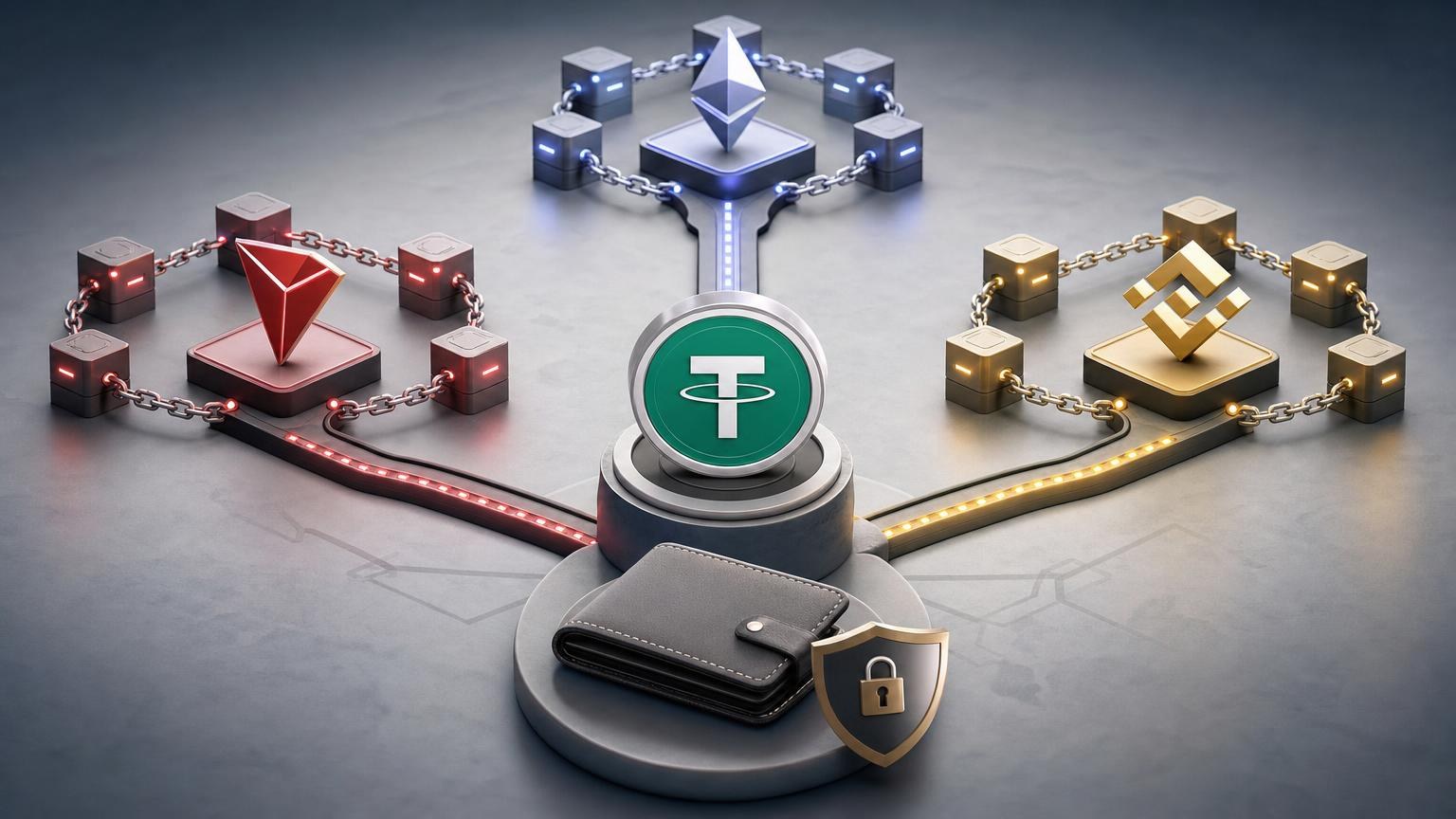
TRC-20, ERC-20 and BEP-20 do not describe three different versions of the US dollar. In an exchange request, they describe the blockchain route used to receive or send a USDT-denominated token. The practical choice is therefore determined first by compatibility: the sending platform, receiving platform, wallet and exact token contract must all support the same network.
What is actually being compared?
USDT can exist on more than one blockchain. Each network keeps a separate ledger, applies its own transaction rules and uses its own native asset or resource system to process transfers. A USDT balance on TRON does not automatically become an Ethereum balance, even though both may be displayed as “USDT.” Moving value between chains requires an exchange, a supported cross-chain route or another intermediary mechanism; it is not a normal wallet-to-wallet transfer. Tether describes this type of movement as a chain swap between supported blockchains. [1]
- USDT ERC-20 refers to a token operating under the ERC-20 standard on Ethereum. ERC-20 defines a common interface for fungible tokens, including transfers and balance queries. Ethereum transactions and smart-contract operations require gas paid in ETH. [2]
- USDT TRC-20 refers to a TRC-20 token on TRON. TRC-20 is TRON’s fungible-token standard and is compatible with the ERC-20 interface at the technical level. TRON processes operations through Bandwidth and Energy; when available resources are insufficient, TRX may be consumed under the network’s current rules. [3]
- USDT BEP-20 is commonly used as a label for a USDT-linked token on BNB Smart Chain. BEP-20 is the network’s token standard, and BNB is used for transaction fees. The exact asset needs extra attention: a widely used BNB Smart Chain contract is identified by BscScan as Binance-Peg BSC-USD rather than a native Tether-issued token. The ticker shown by a wallet is not enough to establish the issuer or contract. [4]
The comparison is meaningful only when all three routes lead to the same intended outcome—for example, depositing a USDT-denominated asset to a service that explicitly accepts each listed network. If the destination supports only one network, there is no fee or speed comparison to make: compatibility has already decided the route.
Stop criteria: when a network should be rejected immediately
Before looking at an exchange rate or estimated fee, apply the following filters. Failing any one of them is enough to remove a route from consideration.
- The receiving side does not list the exact network. If a deposit page says “USDT TRC-20,” sending ERC-20 or BEP-20 is not a substitute. A similar token name or address format does not make the networks interchangeable.
- Deposits or withdrawals are suspended. Network support can be temporarily unavailable because of maintenance, liquidity management or operational restrictions. Historical support does not prove current availability.
- The token contract cannot be verified. Anyone can create a token with a familiar name or symbol. The contract shown by the sending service should match the contract accepted by the destination.
- The wallet cannot operate on that network. It must support the relevant chain and token. A token may exist on-chain while remaining hidden in a wallet interface, so the transaction hash and official block explorer are more reliable than the visible token list alone. BNB Chain documentation specifically notes that assets sent on one network will not appear under another network selection. [5]
- You cannot cover the next self-custody transaction. Holding only USDT may be insufficient when you later need to send it. Ethereum normally requires ETH for gas, BNB Smart Chain requires BNB, and TRON uses Bandwidth and Energy with TRX as the fallback when resources are insufficient. [6]
- The route conflicts with the service’s eligibility or compliance requirements. Verification conditions may depend on the exchange direction and the results of compliance checks. Applicable requirements should be confirmed before creating an order, particularly when services or users are subject to different national rules.
Decision matrix based on constraints
| Criterion | Meaning for the exchange | Options that pass or fail | Material limitation | What to verify before deciding |
|---|---|---|---|---|
| Destination network | The deposit or recipient must accept the exact blockchain route | Only explicitly listed networks pass; every unlisted network fails | A matching “USDT” label does not make separate chains compatible | Network name on the deposit page, current deposit status and any required memo or additional field |
| Exact token identity | The destination must recognize the contract being transferred | ERC-20, TRC-20 or BEP-20 passes only when the accepted contract matches | On BNB Smart Chain, the asset may be a pegged representation rather than a token issued directly on that chain by Tether | Contract address, issuer description, token symbol and official explorer record |
| Wallet and application compatibility | The wallet must connect to the correct network and display or manage the token | Ethereum applications favour ERC-20; TRON applications require TRC-20 support; BNB Smart Chain applications require BEP-20 support | Ethereum and BNB Smart Chain addresses may look similar, but appearance alone does not identify the selected network | Active network in the wallet, supported token standard and destination instructions |
| Ability to move funds later | A self-custody wallet needs the network’s fee asset or sufficient resources | ERC-20 requires access to ETH; TRC-20 requires adequate TRON resources or TRX; BEP-20 requires BNB | An exchange may charge its own withdrawal fee instead, so wallet gas and platform fees are different cost layers | Wallet balance for fees, platform withdrawal charge and whether the fee is deducted from USDT or paid separately |
| Total exchange cost | The relevant figure includes the quoted exchange rate, service charge, withdrawal fee and any later network transaction | No network passes automatically | Fees and network conditions change; old comparisons may be misleading | Final amount to be received, all displayed charges and a current wallet fee estimate |
| Required completion state | The recipient may credit funds only after its chosen number of confirmations | Any supported network may pass | Block production and service crediting are separate stages; an on-chain success does not guarantee immediate account credit | Current network status, required confirmations and the recipient’s crediting policy |
| Availability for the intended amount and direction | The service must support the asset, network and exchange route together | Only currently available directions pass | Support for USDT does not imply that every network, pair, amount or direction is open | Current route availability, limits, quoted amount and verification requirements before creating the order |
How one constraint changes the appropriate route
Receiving funds at an Ethereum-only address
If the recipient accepts USDT only on Ethereum, ERC-20 is the applicable route. A currently lower quoted withdrawal charge for TRC-20 or BEP-20 would not make either compatible. The decisive constraint is the destination network, while the current Ethereum gas level and service fee matter only after compatibility is established.
Sending to a TRON wallet and moving the funds again
TRC-20 may fit when the recipient explicitly supports TRON. The next question is whether the wallet has enough Bandwidth and Energy or sufficient TRX for a later transfer. This matters because receiving a token and being able to send it onward are separate capabilities under TRON’s resource model. [7]
Using the funds inside BNB Smart Chain
BEP-20 may be suitable when the destination is a BNB Smart Chain wallet or application and the exact contract is supported. If the receiving service accepts only Tether-issued USDT on another blockchain, however, a Binance-Peg representation on BNB Smart Chain may fail the asset-identity requirement even when its displayed value tracks the same unit. Contract verification therefore becomes the deciding constraint.
These examples do not produce a universal winner. Changing only one condition—the recipient’s network, the intended application or the accepted contract—can change the valid route before fees are considered.
Stable properties versus details that require a current check
The token standards, underlying networks and native fee mechanisms are relatively stable architectural properties. ERC-20 belongs to Ethereum, TRC-20 belongs to TRON, and BEP-20 belongs to BNB Smart Chain. Their current cost and practical transfer time are not fixed properties.
Before an exchange, check the live quote, withdrawal charge, expected received amount, minimum and maximum limits, network status, required confirmations and current route availability. Ethereum gas varies with network demand and transaction settings. TRON resource parameters can be changed through network governance, while platforms may apply fees that differ from the blockchain’s direct cost. [6]
To compare the options available for a specific operation, check the current USDT exchange routes and supported networks. Availability should be confirmed before creating an order because support for USDT does not mean that every pair, direction or network is active.
Final checks before sending USDT
- Copy the address from the destination instead of typing it, then compare the beginning and end of the pasted value.
- Confirm the network separately on both the sending and receiving screens.
- Verify the token contract when using a self-custody wallet or a route with a pegged asset.
- Review the final amount the recipient is expected to receive rather than comparing one fee in isolation.
- For a new address or unfamiliar route, consider a small test transfer if the platform’s minimums and fees make that practical.
- Use the official service interface and treat unsolicited support messages, copied advertisements and wallet prompts as possible phishing attempts.
Blockchain transfers are generally difficult or impossible to reverse after confirmation. A correct-looking address on the wrong network can still lead to loss or require a recovery process that the recipient may not offer. USDT also reduces exposure to ordinary cryptocurrency price movements but does not remove issuer, platform, smart-contract, liquidity or regulatory risk. Rules and service availability can differ by country, so the applicable conditions should be checked for the parties and services involved.